Getting a passport photo of a baby sounds like it should take two minutes. In practice, it can turn into ten attempts, one dummy negotiation and a lot of wondering whether that tiny shadow behind their head will cause a rejection. If you need passport photos for babies, the good news is that the rules are manageable once you know what actually matters.
This is one of those jobs where a little preparation saves a lot of time. Babies do not pose on cue, they do not sit still for long, and they rarely care whether their eyes are open at the right moment. But passport standards are still strict, so it helps to work methodically rather than trying to get lucky.
What matters most with passport photos for babies
For baby passport photos, the main aim is the same as for adults - a clear, recent image that shows the child’s face properly against a plain background. The difference is that there is a bit more flexibility for babies, especially newborns and very young infants who cannot support themselves.
The photo still needs to be sharp, well lit and free from heavy shadows. Your baby should be on their own in the picture, looking towards the camera if possible, with no toys, hands or blankets covering the face. The background should be plain and light, and the image must not include another person, even partially.
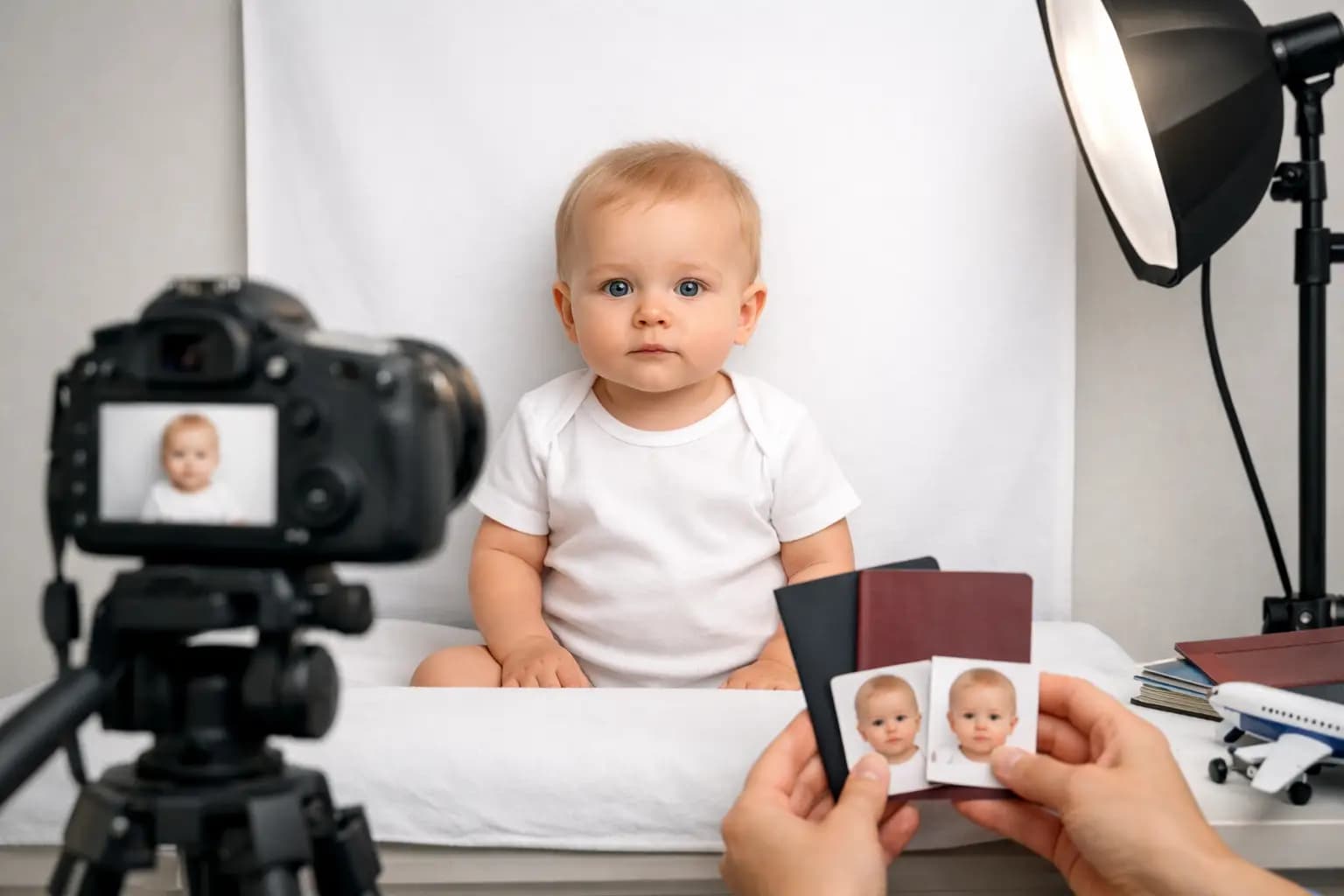
That last point catches many parents out. If a baby is being held, the supporting hand or shoulder cannot appear in the image. If you are taking the photo at home, it is usually easier to lay the baby flat on a plain sheet or blanket than to try to support them upright.
UK baby passport photo rules in practical terms
The official guidance can feel a bit rigid when you are dealing with a wriggling six-month-old. In real life, the best approach is to focus on the parts that are checked most closely.
The face needs to be fully visible. Hair should not cover the eyes. Hats and headbands should be removed unless there is a genuine medical reason. Dummies must be out. If your baby uses one to settle, take a few test shots first and only remove it when you are ready to capture the image.
Expression matters less for babies than for older children and adults. They do not need a perfect neutral expression, but the mouth should ideally be closed and the eyes open. For newborns, there can be a little more tolerance, but a clear, front-facing image is still the target.
Lighting should be even. Strong overhead lighting can cast shadows under the chin or behind the head, and direct flash often creates glare or a washed-out skin tone. Daylight near a window usually works better than a bright ceiling light.
Do babies need to look straight at the camera?
Ideally, yes. The photo should show the full face, with the baby facing forward. That said, very young babies are given some allowance because they cannot always focus on the lens or hold a steady position.
A slight gaze off-centre may still be acceptable for an infant, but a strong turn of the head is more likely to cause a problem. If you can get their attention briefly with your voice or a familiar sound from behind the camera, that usually helps.
Can a baby lie down for the photo?
Yes, and for many parents this is the easiest option. Put a plain white or cream sheet on a flat surface and lay the baby down safely. Make sure the material is smooth behind the head so the background looks clean and not too creased.
Take the photo from directly above, keeping the camera level. This angle helps avoid distortion and makes it easier to keep the baby centred in the frame.
Common reasons baby passport photos are rejected
Most rejections come down to simple technical issues rather than the baby’s expression. A lovely photo is not always a compliant one.
One common problem is background clutter. A cot pattern, coloured blanket or visible cushion can all cause trouble. Another is shadowing, especially around the head. If the face is not evenly lit, the image may not pass.
Blur is another frequent issue. Babies move quickly, even when they seem still, so a photo can look fine on a phone screen and turn out slightly soft when checked properly. It is worth taking several images in quick succession rather than relying on one.
Parents also often submit photos with support visible in the frame. A hand under the baby’s neck, a sleeve at the edge of the image, or part of a car seat can all mean starting again. Jewellery, bibs and bulky clothing around the chin can also interfere with the outline of the face.
Taking passport photos for babies at home
If you want to do it yourself, keep the setup simple. Choose a time when your baby is calm, fed and awake, but not overtired. Mid-morning often works better than trying just before a nap.
Use natural light where possible. Lay the baby on a plain light-coloured sheet near a window, but not in direct sun. Stand over them and take the photo straight down. Keep the frame tight enough to show the face clearly, but leave enough space around the head and shoulders for proper cropping.
Take more shots than you think you need. Babies change expression and direction in seconds, so volume helps. It is much easier to review ten usable photos than to realise later that your one good attempt is slightly blurred.
If the baby is older and can sit with support, you can also seat them in front of a plain background. Just make sure nothing behind them creates a shadow line or visible crease at head height.
When a professional service makes more sense
There is a point where taking the photo yourself stops being the easy option. If you have already tried a few times, if your baby is very unsettled, or if you simply want reassurance that the photo meets the standard, a professional passport photo service is usually quicker overall.
A proper photo service can help with positioning, lighting and cropping, which are the areas most likely to cause rejection. That is especially useful if you are working to a deadline or applying for a first passport before travel.
For many families, the real benefit is reducing repeat effort. One correct photo is better than half an hour spent retaking images, checking dimensions and second-guessing whether the background is plain enough. At Photo Zone, for example, the focus is on getting the job done correctly and without fuss, which is exactly what most parents want.
Timing, clothing and other small details
Dress your baby in plain clothes that contrast gently with the background. If they are lying on a white sheet, avoid a white babygrow if possible, as it can make the outline less clear. Darker or mid-tone clothing tends to work better.
Keep accessories to a minimum. Large bows, hooded tops and heavy collars can all get in the way. The face should be the clear focus of the image.
It is also worth checking the baby’s face before you start. A milk mark, damp chin or sleep crease can be more obvious in the final photo than in person. A quick wipe and a minute to settle can improve the result.
Digital or printed baby passport photos
What you need depends on how you are applying. Some passport applications use a digital photo, while others may still require printed images for certain documents or related visa applications.
Digital photos need to meet the correct size and quality requirements, and printed photos need accurate cropping and print quality. This is where many home attempts fall short. The image itself may be acceptable, but the output is not. If you are not fully sure which format is needed, check before you take the photo so you do not have to start from scratch.
A calmer way to approach the job
The easiest mistake is expecting the process to be quick because the subject is small. In reality, baby passport photos take patience more than anything else. Build in a little extra time, keep the setup straightforward and aim for clear and compliant rather than perfect.
If your first attempt is not right, that does not mean you are doing anything wrong. Babies are unpredictable, and the standards are precise. A simple setup, good lighting and a few extra shots usually solve most problems. And if not, getting help from a photo service can save time, especially when travel plans are already filling the diary.
A passport photo is a small job, but it is one worth getting right first time - particularly when the person in front of the camera would rather be anywhere else.