
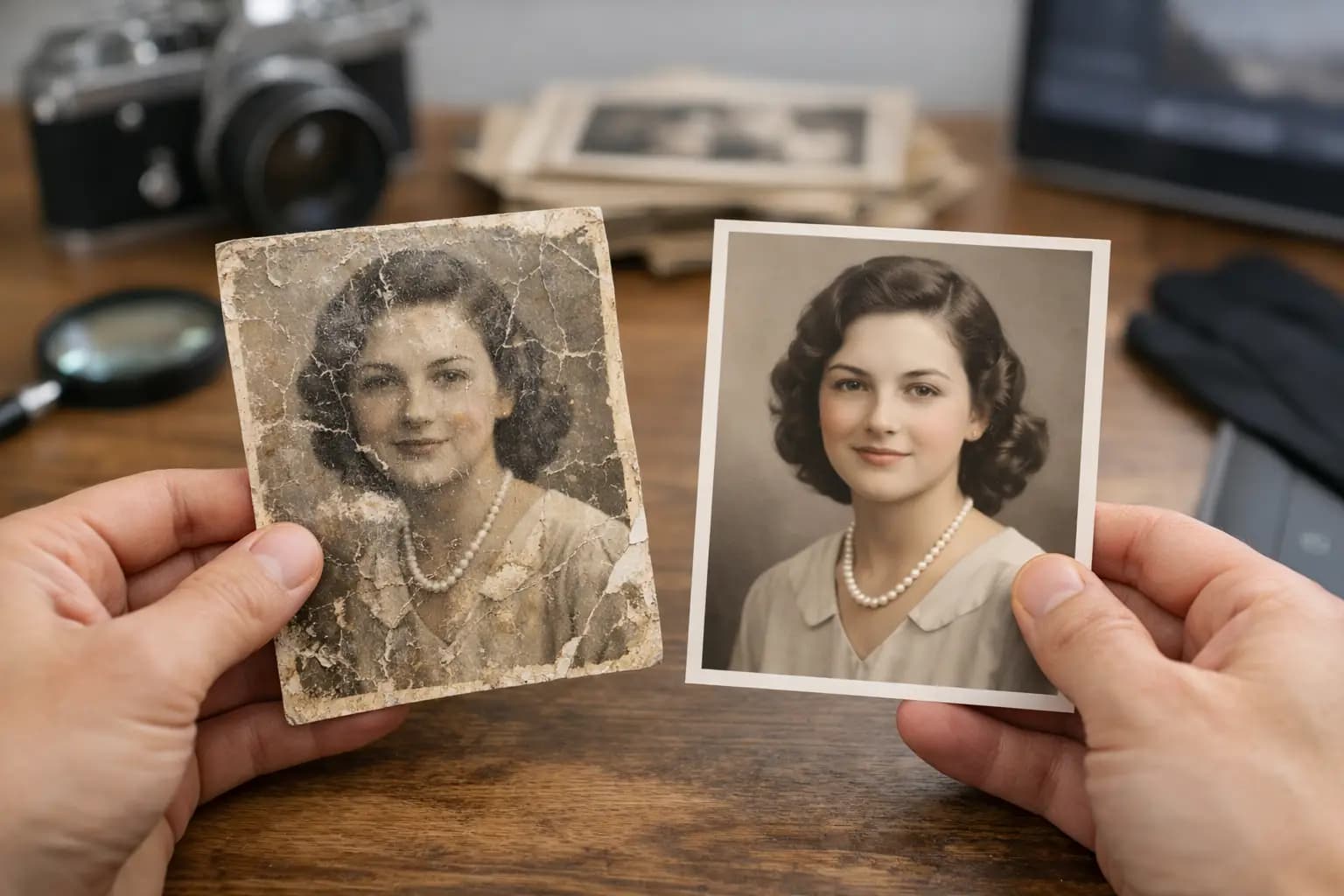
A faded family photo can look beyond saving until you place the damaged original next to the finished version. That is why before and after photo restoration matters so much. It gives you a clear idea of what can be repaired, what may still show slightly, and whether a treasured print is worth restoring before you reprint, frame or share it.
For most customers, the real question is simple. Can this photo be improved enough to keep, display or give as a gift? In many cases, the answer is yes. Tears, creases, fading, stains and surface marks can often be reduced or removed, but the final result depends on the condition of the original and how much image detail is still there.
What before and after photo restoration really shows
A strong before and after photo restoration example is not just about making an old image look newer. It shows the practical difference between a damaged print and a usable one. That might mean bringing back facial detail lost in a faded snapshot, correcting discolouration in an old wedding portrait, or removing fold lines from a picture that has been kept in a drawer for years.
The best restorations improve the image while keeping it believable. If a photograph was softly focused to begin with, restoration should not make it look artificially sharp. If part of the picture is missing altogether, any repair work has to be handled carefully. Good restoration is about improving what is there, not inventing a completely different photo.
This is why before and after examples are useful. They help set realistic expectations. Some images can be transformed dramatically. Others will improve more modestly, especially when damage affects faces, fine detail or large sections of the print.
Common problems restoration can fix
Most damaged prints do not fail in just one way. A single photo may be faded, creased and stained at the same time. Restoration work usually deals with a mix of issues rather than one isolated fault.
Fading and colour shift
Older prints often lose contrast over time. Blacks go grey, whites turn dull, and skin tones drift into yellow, red or blue. This is one of the most common improvements shown in before and after photo restoration. Restoring contrast and correcting colour can make a picture look far clearer without changing its original character.
Black and white photos can also fade. In these cases, the aim is usually to restore tonal balance so faces, clothing and backgrounds are easier to see again.
Creases, tears and folds
Photos stored loose in boxes or albums often pick up fold marks and torn corners. Surface damage like this can usually be repaired well, especially if the missing area is small. Fine cracks and scratches are also common and can often be removed cleanly.
Where a tear cuts through important detail, such as an eye or mouth, results can vary. The repair may still look excellent in print, but the amount of original information available makes a difference.
Stains, spots and marks
Water marks, dust spots, fingerprints and age-related staining can all distract from the image. These are often among the easiest issues to improve, provided they sit on the surface and have not removed the image underneath.
Mould damage is more unpredictable. Sometimes it leaves staining that can be reduced. In more severe cases, it may have permanently affected the photograph's surface.
Missing edges or damaged corners
If a corner has snapped off or the border is heavily worn, restoration can often rebuild the missing area so the final image looks complete again. This tends to work best where surrounding patterns, clothing or background areas give enough visual reference.
If key features are missing, especially from faces, the repair may still be possible but will depend on the image quality and how much of the original remains.
What affects the final result
Two photos with similar damage can produce very different results. The starting point matters more than many people expect.
The first factor is image quality. A sharp original with good contrast usually restores better than a blurry, low-detail print. The second is the extent of damage. Surface marks are one thing. Missing detail is another. Restoration can correct many faults, but it cannot always fully replace information that has disappeared.
Size also matters. A small print can look fine in the hand, but once scanned and enlarged, extra flaws may become visible. That does not mean restoration is unsuitable. It just means the work may need to be handled with care, especially if you plan to order larger reprints or wall art afterwards.
The condition of the original print matters as well. If the photo is bent, stuck in an old album, or printed on heavily textured paper, the scanning and restoration process may be more complex. In those cases, a specialist service is usually the safer option.
Before and after photo restoration for printing
Restoration is often most worthwhile when you plan to print the image again. A repaired digital file can be used for standard prints, framed products, albums or gifts, giving old photographs a second life instead of leaving them stored away.
This is where before and after photo restoration becomes especially practical. You are not just improving a file on a screen. You are preparing an image to be displayed properly. A restored photograph that still has slight age character can look excellent as a print, even if it is not perfectly flawless when viewed at high magnification.
That is worth remembering. Screen viewing can make customers focus on tiny details they would never notice in a finished print. What matters most is how the restored image looks at its intended size.
How to prepare photos for restoration
If you are sending a print for restoration, a little preparation helps. Handle the photo by the edges and keep it as flat as possible. Do not try to clean it with household sprays or wipes, as these can cause permanent damage. If the print is dusty, a light and careful brush with a soft dry cloth is usually safer than aggressive cleaning.
If you have more than one copy of the same image, keep them all. One version may have less fading, while another may have fewer scratches. Combining reference from multiple copies can sometimes improve the final result.
It also helps to explain what matters most to you. If the priority is repairing a face, restoring natural skin tone, or keeping the original sepia look, say so at the start. Restoration is not only about what can be done. It is also about what should be preserved.
When expectations need to stay realistic
Restoration can achieve a lot, but not every problem disappears completely. If a photo is badly blurred, severely overexposed, or has large areas missing, the result may still show some limitations. That does not make the process poor value. Often, a significantly improved version is far better than leaving the image damaged and unused.
It also depends on how the photo will be used. A family album print may not need the same level of perfection as a large framed enlargement. For some customers, removing the main distractions is enough. For others, especially with formal portraits, a more detailed restoration may be worthwhile.
This is one reason specialist help matters. A good service will be clear about what is likely, what is less certain, and how the final file is best used.
Why professional restoration is often the safer choice
Apps and quick filters can brighten an image, but proper restoration usually needs more than an automatic fix. Tears, stains, missing detail and localised fading all need careful manual work if the final image is to look natural.
That is especially true for sentimental photographs. Once a print is damaged further, there may be no second chance. Using a trusted photo service gives you a better chance of preserving the image properly from the start. For customers who also want fresh prints afterwards, it makes sense to keep scanning, restoration and printing within one reliable process. That practical, joined-up approach is one reason many customers choose services like Photo Zone.
Is restoration worth it?
If the photograph matters to you, it usually is. The value is not only in repairing damage. It is in making the image usable again, whether that means printing copies for family, adding it to an album, or finally framing a picture that has spent years out of sight.
Before and after photo restoration is helpful because it turns an uncertain decision into a clear one. You can see the likely improvement, weigh up the condition of the original, and decide how you want to use the restored image next.
If you have an old print tucked inside a drawer, album or envelope, do not assume the damage is the end of the story. A careful restoration can often bring back far more than you expect, and sometimes that is all it takes to put an important memory back where it belongs.