
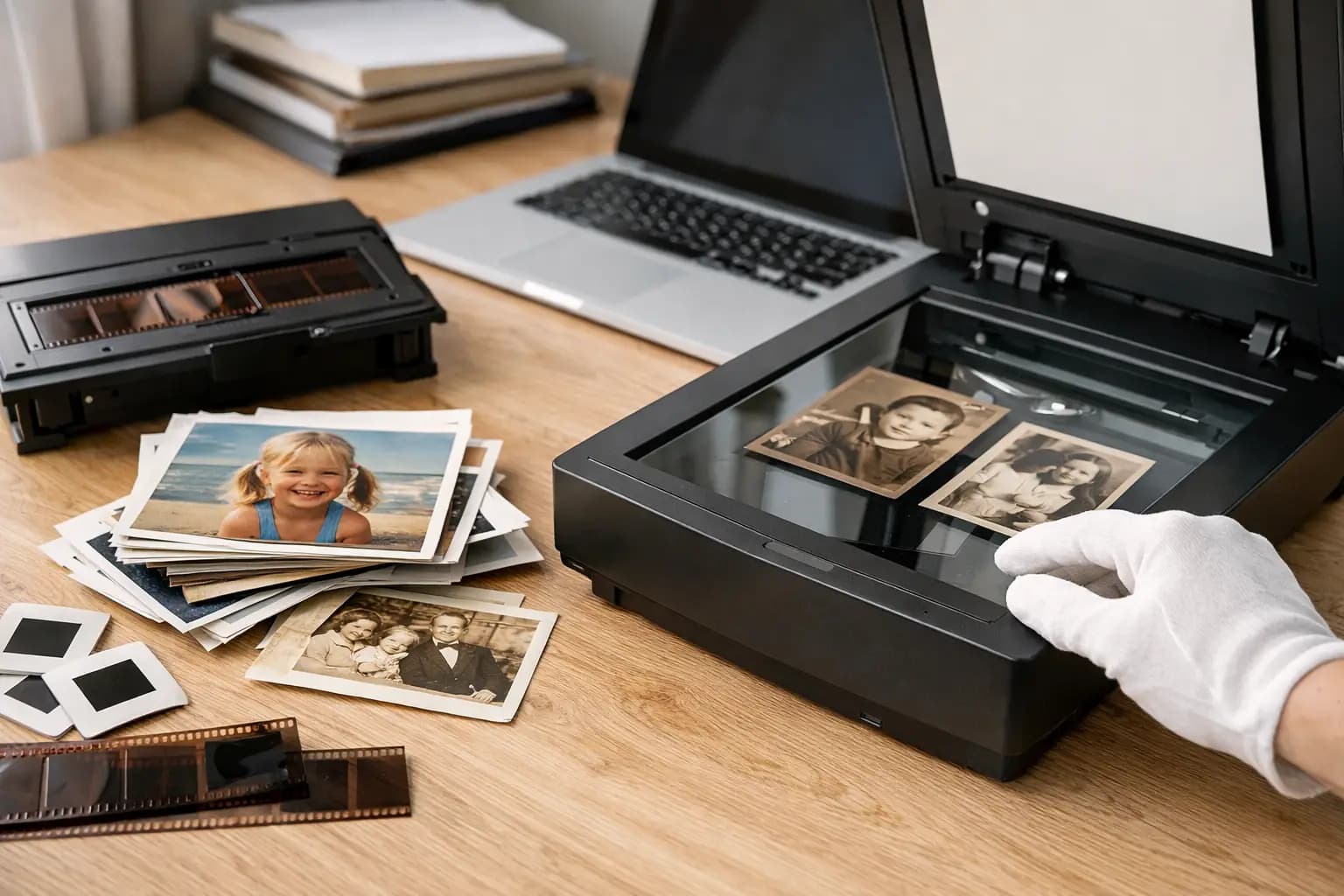
A shoebox of old prints usually starts as a small job. Then you find another envelope, a loose album, a packet from the chemist, and suddenly you have years of family photos that are fading, curling or simply hard to share. A photo scanning service UK customers can rely on makes that collection easier to protect, organise and enjoy again.
Why use a photo scanning service in the UK?
Scanning photos at home sounds simple until you start doing it properly. Flatbed scanners take time, phone apps can vary in quality, and older prints often need careful handling to avoid dust marks, glare and missed detail. If you have more than a handful of photos, the job can quickly become repetitive.
A professional photo scanning service in the UK is usually the better option when speed, consistency and image quality matter. Your prints are handled in batches, scanned at a suitable resolution, and supplied in a digital format that is easy to store, copy and share. That matters if you are preserving family history, preparing images for reprints, or sending copies to relatives.
There is also the practical side. A UK-based service means your order stays closer to home, turnaround is generally faster, and support is easier if you have questions before or after sending your photos.
What a good photo scanning service UK provider should offer
The basics should be straightforward. You want clear pricing, sensible turnaround times and simple instructions for getting your photos to the lab, whether that is by post or in store. If the process feels vague at the start, it rarely gets better later.
Image quality is the next point to check. Good scans should be sharp, evenly exposed and suitable for everyday use, from storing on your computer to ordering fresh prints. Not every customer needs museum-grade archival work, but you do need files that look clean and faithful to the original print.
Handling is just as important as equipment. Older photographs can be delicate, especially if they have been stored in lofts, garages or old albums. A dependable service should treat them carefully, keep orders organised and return originals securely.
You should also look for flexibility. Some customers have standard 6x4 prints in neat stacks. Others have mixed sizes, older square formats, mini prints, or photos stuck into albums. A capable lab will explain what it can scan, what may need extra care, and where limitations apply.
Quality matters, but so does the right resolution
One of the most common questions is whether higher resolution always means a better result. Not necessarily. It depends on what you want to do with the files afterwards.
If your goal is to back up family photos and share them digitally, a sensible scanning resolution is often enough. If you may want to enlarge older prints or use them in framed displays, a higher setting can be worthwhile. The best approach is practical rather than technical. You need scans that are good enough for your intended use without paying for oversized files you will never need.
This is where a specialist service is helpful. Instead of guessing settings at home, you can choose a service built around common photo sizes and real-world output. That keeps the process simpler and often more cost-effective.
Photo scanning versus restoration
Scanning and restoration are related, but they are not the same job. A standard scan creates a digital copy of the print as it exists now. If the original has fading, scratches, creases or torn edges, those issues will still appear in the scan.
Restoration is the extra step. That usually involves correcting colour, repairing damage and improving the overall look of the image. Not every photo needs that level of work. Many customers only want a clean digital version of the original print, especially when dealing with large family collections.
If you have a few important photos that are badly damaged, it can make sense to scan the full set and then restore selected favourites separately. That keeps costs under control while still giving special attention to the images that matter most.
How to prepare photos before sending them
Preparation does not need to be complicated, but it does help. Start by removing any obvious duplicates you do not want scanned. If photos are grouped by family, year or event, keep them in that order. It saves time later when you are naming folders or sharing files.
It is also worth checking for anything that needs to be flagged in advance. Very old prints, fragile album pages or mixed media collections may need a different approach from loose standard photos. If a picture has writing on the back that matters, mention that too, as customers sometimes want both sides preserved.
Do not try to clean delicate photos with household products. If there is loose dust, leave it alone unless you know the print can be handled safely. Over-cleaning causes more problems than it solves.
In-store or postal scanning?
For many people, this comes down to convenience. If you are near a branch, in-store drop-off gives reassurance. You can speak to someone, ask questions and hand the order over directly. That is particularly useful for first-time customers or mixed collections that need a quick explanation.
Postal scanning suits customers who want the same specialist service without travelling. It is often the simplest option if you live elsewhere in the UK or have a larger batch to send. The key is good packaging and clear labelling, so your photos stay protected in transit and easy to identify on arrival.
Neither option is automatically better. It depends on where you live, how quickly you need the job done, and whether you prefer face-to-face service or the convenience of posting from home.
What affects price?
Most customers want to know the cost before anything else, and fairly so. Pricing usually depends on quantity, photo size, and whether the job is standard scanning or includes extra work such as sorting, rotation or restoration.
Large batches often work out better value per photo than very small orders. Standard loose prints are usually the most straightforward to process, while unusual sizes or photos fixed into albums may take longer. If you are comparing services, make sure you are comparing like for like. A lower headline price is not always cheaper if return delivery, file transfer or minimum order charges are added later.
The best value is not simply the cheapest option. It is the service that gives you usable files, careful handling and a clear process without wasting your time.
Choosing a service you can trust
Trust matters when you are handing over irreplaceable family photos. A dependable provider should make the process feel clear from the start. You should know what happens after your order is received, how long scanning is likely to take, and how your originals will be returned.
Look for plain-English service information rather than vague promises. Fast turnaround is useful, but only when paired with proper handling and consistent quality. Verified customer feedback, physical store presence and established photo lab experience can all help you feel more confident about sending valuable originals.
This is where an established UK lab can make a real difference. For customers who want a practical service without fuss, Photo Zone offers specialist scanning support alongside everyday photo printing, film processing and other image services, with both in-store and postal options available.
When scanning is worth doing now
Old prints rarely improve with age. Colours fade, surfaces pick up scratches, and storage conditions are not always ideal. Even if photos look fine today, it makes sense to digitise them before damage becomes harder to manage.
Scanning now also makes the images useful again. Once digitised, they are easier to back up, share with family, include in albums, reprint as gifts, or use for framed displays at birthdays, anniversaries and memorials. That is often the real value of the service. It is not just preservation for the sake of it. It is about making old photos accessible in a format that fits modern life.
If you have been putting the job off, start with one box, one album or one family branch. You do not need to tackle everything at once. The important thing is getting those prints out of storage and into a format you can keep, copy and enjoy with less risk of losing them for good.
A good scanning service should make that first step feel simple, not technical, and leave you with digital photos you can actually use.