
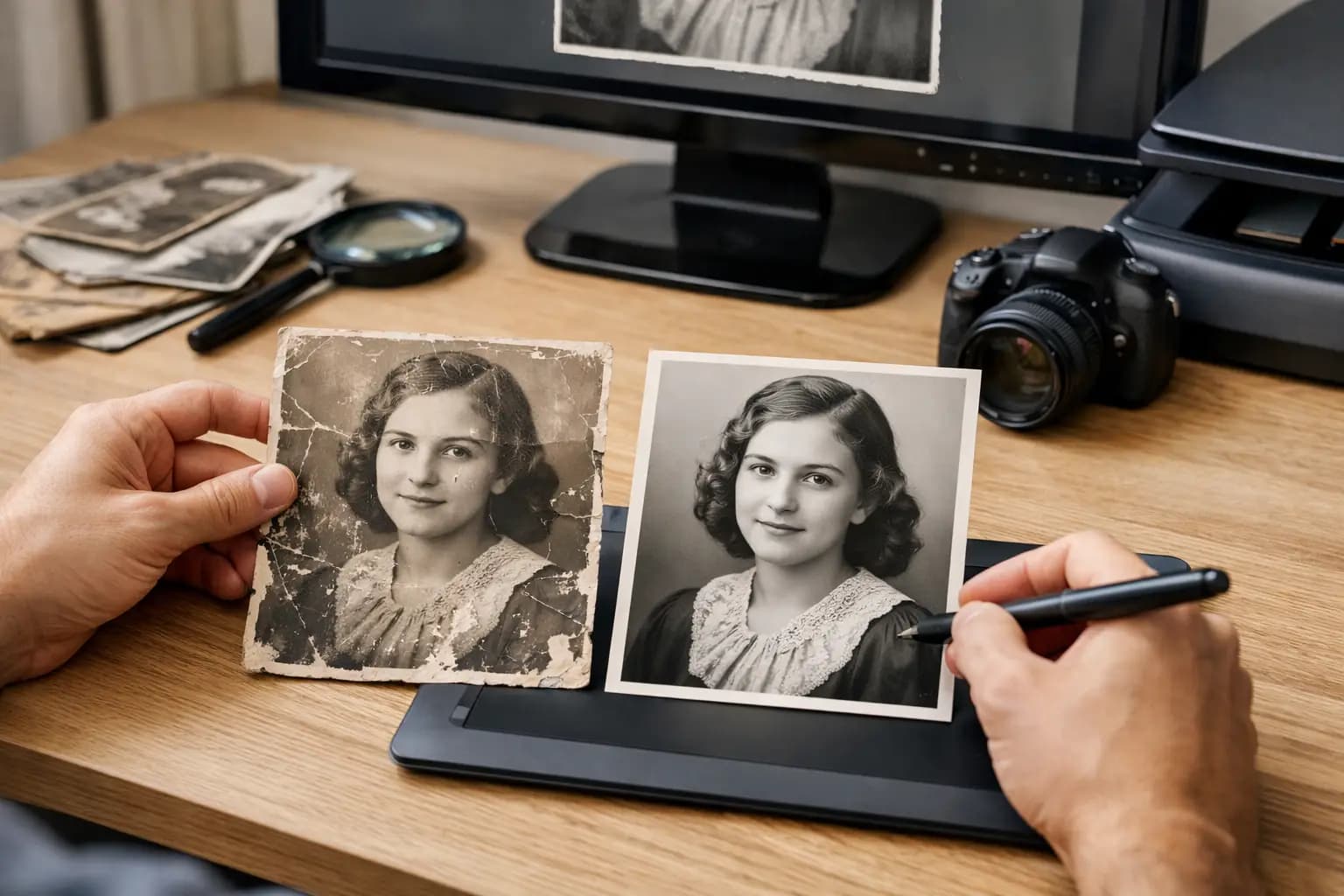
A faded family portrait tucked into a drawer can look beyond saving at first glance. In practice, a good old photo restoration service can often recover far more detail than most people expect, whether the damage is light fading, creases, stains or small tears that have built up over the years.
What an old photo restoration service actually does
Photo restoration is the process of repairing damage on a scanned or digitised image so it looks cleaner, clearer and closer to the original photograph. That might mean correcting fading, removing dust marks, reducing scratches, repairing cracks, or rebuilding small missing areas.
The key point is that restoration is usually carried out on a digital copy, not by painting or physically altering your original print. That matters because it protects the original item while giving you a restored version that can be saved, shared and printed again.
The best results come from balancing repair with realism. If a photo is restored too heavily, skin can look artificial and textures can start to disappear. If it is restored too lightly, the damage remains obvious. A reliable service aims for a natural finish rather than an over-edited one.
When restoration is worth doing
Not every old photograph needs major work. Some only need a gentle tidy-up before printing, while others benefit from more detailed repair. It depends on the condition of the image, how you plan to use it, and how much sentimental or practical value it holds.
If you want to frame a wedding portrait, include a family photo in a memorial display, or turn a heritage image into a gift, restoration is often worthwhile. The same applies if you only have one surviving copy and want to protect it by creating a clean digital version.
There are also cases where a simple scan is enough. A photograph with mild fading but no serious damage may not need full restoration. That is why it helps to use a service that can assess the image properly instead of pushing every order into the same level of editing.
Common problems an old photo restoration service can fix
Most damaged prints fall into a few familiar categories. Surface marks such as dust, scratches and specks are usually the simplest to remove. Creases, fold lines and small tears can often be repaired cleanly, especially when the surrounding detail is still visible.
Fading is another common issue, particularly with prints that have been stored in sunlight, lofts or damp conditions. Restoration can improve contrast and bring back lost definition, although heavily faded areas may need more careful reconstruction.
Discolouration is also common in older prints. Yellowing, colour shifts and uneven tones can often be corrected, but the exact result depends on how much original information remains in the image. If the original print has lost a lot of detail, no service can recreate every element perfectly.
More complex work includes rebuilding missing corners, repairing water damage and improving images that have stains across faces or clothing. These jobs are possible, but they take more time and skill. In those cases, a cheap automated edit is rarely enough.
What to expect from the process
A straightforward old photo restoration service usually starts with a clear image source. That may be a posted original, a scanned copy, or a high-quality mobile phone photo if the print is flat and evenly lit. Better source material gives better results, so image quality at the start makes a real difference.
Once the image is reviewed, the level of work should match the damage. Light restoration may cover dust, scratches and basic tonal correction. More advanced restoration may involve detailed manual retouching, rebuilding damaged sections and correcting colour in stages.
After editing, you should receive a restored digital file and, if needed, the option to order fresh prints in the size and finish you want. This is where using a provider with both restoration and printing expertise can be especially practical. It keeps the process simple and helps ensure the finished print looks right, not just the screen version.
How to choose the right old photo restoration service
The right choice usually comes down to trust, realism and convenience. You want a service that handles originals carefully, explains what can be achieved, and offers a clear route from damaged print to finished copy.
Start with quality. A service should focus on natural-looking repair, not heavy filtering. Faces should still look like real people. Clothing, hair and background textures should not be blurred away just to make the image look cleaner.
Next, consider turnaround. If you need a restored print for a birthday, anniversary or family event, speed matters. Fast service is useful, but only if the work remains accurate. Quick delivery and proper lab-quality printing are a better combination than rushed editing with weak print output.
Pricing should also be clear. Restoration work varies in complexity, so costs may depend on the amount of repair needed. That is reasonable. What matters is knowing what you are paying for and whether the result includes a digital file, a print, or both.
Finally, think about ease. Many customers want a simple process without technical steps or account setup. Being able to order online, send images by post where needed, and get support from a UK-based team removes a lot of friction.
Why scanning and printing matter as much as the edit
Restoration is only one part of the job. If the scan is poor, the edit has less to work with. If the print quality is poor, even a strong restoration can look flat or inaccurate once it is produced.
A proper scan captures detail in shadows, highlights and fine textures. That gives the editor more room to repair damage without forcing the image. It is especially helpful for older black and white prints, where subtle tonal range can make a big difference.
Printing matters just as much. Skin tones, contrast and sharpness can all shift between screen and print. A UK photo lab that handles both the restoration and the final print is often the safer option, because the image can be prepared with the output in mind from the start.
Setting realistic expectations
This is the part many people skip, but it is worth being honest about. Restoration can do a great deal, but it cannot perform miracles on every image.
If a photo is badly blurred, heavily overexposed, or missing large sections of detail, the final result may still show limits. A good service will improve the image as far as practical without pretending that every damaged print can be made to look brand new.
That does not mean the work is less valuable. Often the aim is not perfection. It is preserving a memory in a form that is cleaner, safer and easier to share with family. For many customers, that is exactly what matters.
When local support makes a difference
For specialist services like restoration, local support can be reassuring. Some customers prefer to hand over originals in store rather than post irreplaceable prints, while others simply want the confidence of dealing with a UK business that can answer questions clearly.
That blend of online convenience and physical service is useful for older family collections, where every image may have different needs. One print might need a basic reprint, another may need scanning, and a third may need full restoration before it is ready for framing or gifting.
For customers who want a practical and reliable route from damaged photo to finished print, Photo Zone offers the kind of straightforward service that suits the job - specialist support, UK lab production and an easy ordering process without unnecessary steps.
A restored photo should be used, not just saved
Once a photograph has been restored, it becomes easier to do something with it. You can print copies for relatives, add it to an album, frame it for the wall, or keep a digital version safely backed up instead of relying on one ageing original.
That is often the real value of restoration. It takes a photo that has become fragile or hard to enjoy and puts it back into everyday life. If you have a picture that matters to your family, getting it assessed by a dependable old photo restoration service is a practical step that can make that memory easier to keep and easier to share.