
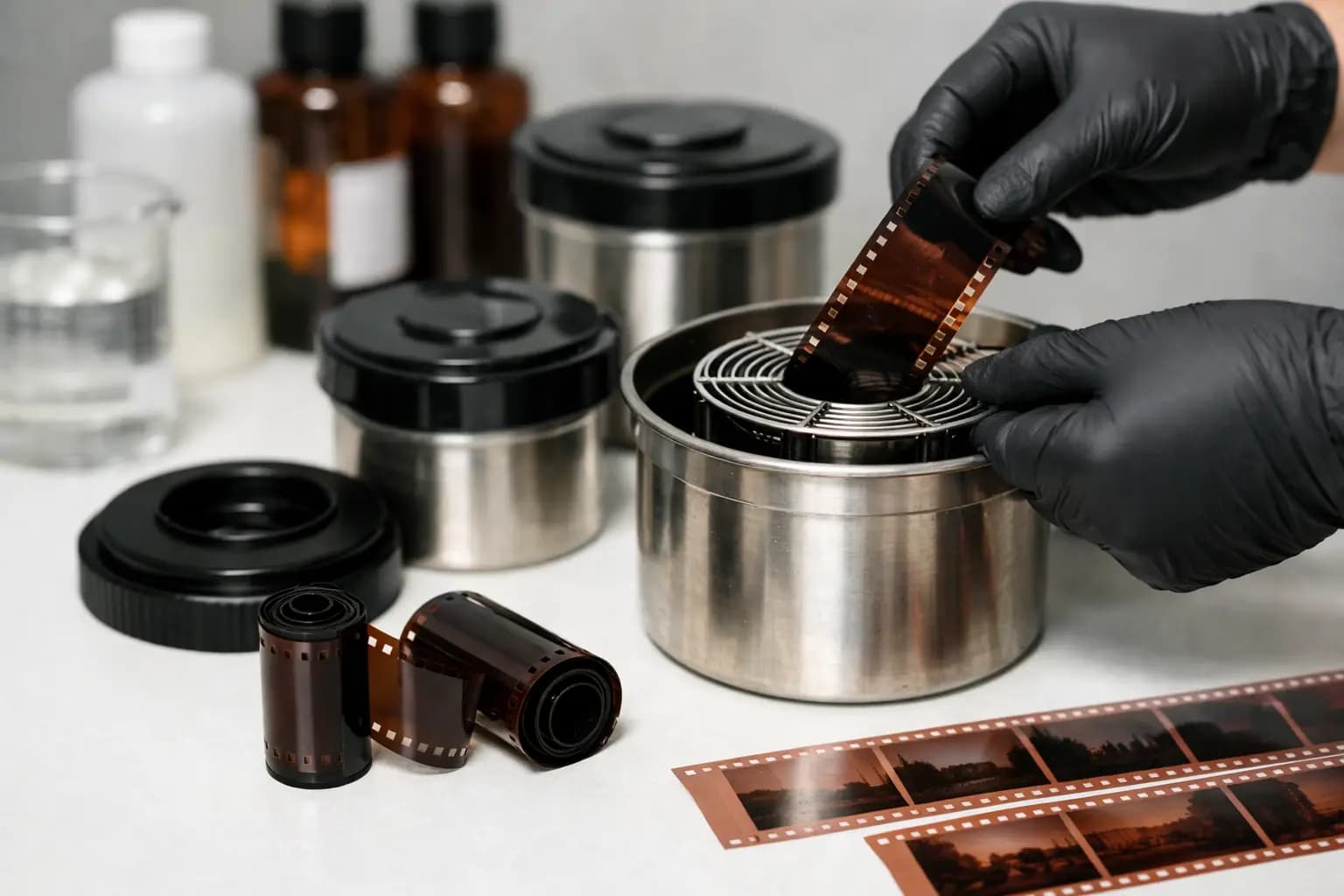
A roll of 120 film usually holds fewer frames than 35mm, costs more to buy, and often captures some of your best images. That is exactly why choosing the right 120 film developing service matters. When you have invested time, travel and care into medium format photography, you want processing that is straightforward, consistent and handled by a lab you can trust.
What a 120 film developing service actually covers
A 120 film developing service is the lab process for medium format film. That usually means developing the film itself, returning your negatives safely, and in many cases offering scans so you can view, share and print your images digitally.
The exact service can vary depending on the film stock. Colour negative film is commonly processed in C-41 chemistry. Black and white film uses its own process, and slide film uses E-6. If you are sending film to a lab, it helps to check which film types they accept rather than assuming every service covers every format and chemistry.
For most customers, the practical question is simple: do you want development only, or development and scans? If you shoot regularly and do your own scanning at home, development only may be enough. If you want the quickest route to seeing your images, scans make life easier and give you files ready for your mobile phone, computer or print order.
Why medium format needs careful handling
120 film is not complicated, but it does need proper handling. Unlike 35mm, it has paper backing and a larger image area, and the negatives can be more vulnerable to marks if they are processed or stored carelessly. A good lab will treat clean handling, drying and cutting as basic standards, not optional extras.
This matters because medium format rewards detail. Whether you shoot 6x4.5, 6x6, 6x7 or 6x9, one of the main reasons for using 120 film is the image quality. Better tonality, smoother grain and more detail are all part of the appeal. Poor processing can waste that advantage very quickly.
There is also less room for error emotionally as well as technically. A lot of 120 film is used for portraits, weddings, landscapes and personal projects where each frame counts. If a roll only gives you 10 or 12 exposures, every one feels valuable.
What to look for in a 120 film developing service
The first thing to check is reliability. You want a UK lab that processes film regularly and has a clear, consistent workflow. Fast turnaround is useful, but it should not come at the cost of poor handling or vague communication.
The second is clarity. A good service should make it obvious what is included. Are scans included or extra? Will negatives be returned? Is there a difference in turnaround between colour and black and white? Can you order by post if you are not near a store? Straight answers save time and prevent disappointment.
The third is scan quality. Not everyone needs the highest resolution available, but everyone does need scans that are clean, correctly oriented and suitable for how they plan to use them. If you mainly want to share images online or order standard prints, entry-level scans may be fine. If you want to crop heavily, edit in detail or produce larger enlargements, higher resolution scans are usually worth paying for.
Price matters too, but it is best judged in context. The cheapest option is not always the best value if scan quality is poor, negatives are handled badly or turnaround drags on. Equally, the most expensive service is not automatically better for everyday film shooters. Most customers want a sensible middle ground - dependable processing, good scans and a fair price.
120 film developing service with scans or negatives only?
This is one of the most common decisions, and the right answer depends on how you use your photos.
If you already have a scanner and prefer to manage your own workflow, negatives only can keep costs down. It also gives you more control over colour balance, contrast and final file style. That said, home scanning medium format well takes time, space and patience. It is a good option for enthusiasts, but not always the quickest.
If you choose a 120 film developing service with scans, you get convenience. Your images are ready to review soon after processing, and you can move straight to sharing or printing. For many customers, especially those returning to film after a break, this is the simplest and most practical route.
There is also a middle ground. Some people order standard scans for quick viewing, then request selected images to be printed larger later. That approach works well when you want to keep initial costs sensible while still making the most of your strongest frames.
Posting 120 film to a lab
For many UK customers, post-in film processing is the easiest option. It saves a special trip and gives you access to a specialist lab even if there is not one nearby. The key is packing the film properly and labelling it clearly.
Exposed rolls should be secured so they do not loosen in transit. It also helps to include your contact details, order information and any notes about the film type. If you are sending more than one roll, make sure each one is easy to identify. A simple, organised package reduces the chance of delays.
If your film is particularly important, tracked post is often worth it for peace of mind. That is not about making the process complicated. It is simply a sensible step when you are sending original negatives that cannot be replaced.
Turnaround times and what affects them
Turnaround is one of the first things customers ask about, and understandably so. Once a roll is finished, most people want to see the results quickly. With a professional lab, colour film is often faster to process than black and white, though exact timings depend on workload and the service chosen.
Scanning adds another stage, and postal orders include transit time both ways. That means the fastest service is usually in-store drop-off and collection, while postal processing trades a little speed for convenience. Neither option is better in every case. It depends whether your priority is local access or getting the job done without leaving home.
It is also worth allowing for busy periods. School holidays, Christmas and gift seasons can increase demand across photo services generally. A lab with clear expectations on turnaround is far easier to deal with than one that leaves you guessing.
Common mistakes to avoid before sending your film
The biggest mistake is not identifying the film type properly. Colour negative, black and white, and slide film all need different treatment. If you are unsure what you have shot, check the box, the backing paper or the markings on the roll before ordering.
Another issue is poor storage before processing. Exposed film should be kept cool and dry and sent for development without unnecessary delay. Leaving rolls in a hot car, a damp room or the back of a drawer for months can affect results.
It is also a mistake to focus only on development and forget what happens next. If you know you want prints, enlargements or digital copies for family sharing, think about that when ordering. Choosing scans at the start can save time later.
Who uses 120 film today?
Medium format is not just for specialists. Some customers are long-time film users who prefer the look and discipline of analogue photography. Others have inherited a camera and want to try it properly. Some shoot portraits or landscapes as a hobby, while others use 120 film for meaningful occasions where they want something different from mobile phone pictures.
That range is exactly why a practical, dependable service matters. Most people do not want jargon or gatekeeping. They want to know their film will be processed correctly, their negatives returned safely, and their images delivered in a format they can actually use.
For UK customers looking for a straightforward service, a lab such as Photo Zone makes the process simple by combining specialist film handling with the same practical approach people expect from everyday photo printing.
Getting the best results from your developed film
Once your scans or negatives arrive, take a little time to review them properly. Medium format often shows its strengths in the finer details, so images that look good on a mobile phone can look even better as prints. If you have a few standout frames, it is worth considering enlargements or framed prints rather than leaving them in a folder on your device.
Keep your negatives safe too. Store them flat, dry and away from direct sunlight. Even if you only use the scans now, the negatives are your original record and can be rescanned in future if you want a different finish or larger output.
The main thing is not to let exposed rolls sit forgotten. Good 120 film deserves proper processing, and the right lab makes that part easy. When the service is clear, quick and carefully handled, you spend less time worrying about the process and more time enjoying the pictures.